
Adil Raza Khan | February 26, 2025

When it comes to property management in Dubai, one size definitely does not fit all. Whether property managers are dealing with luxury properties, commercial properties, or residential properties, it is all different. Each property type comes with its own set of tailored services, challenges, and regulations to follow.
If you are a budding property manager or an investor, we shall take you on a deep dive into what it takes to manage different property types in Dubai.
Curated Opportunities
Flexible buying options for smarter property decisions.
Handpicked properties sorted for the strongest value.
Investment-focused listings with return potential.
Browse Dubai communities with properties for sale.
Luxury properties in Dubai are more than just homes, these are ultra-high class residences where you can experience the utmost exclusivity and luxury. From ultra-high-end villas, apartments, penthouses, and mansions, every property screams opulence and extravagance. This also means that managing luxury properties Dubai is not as easy as it seems.
It requires keen attention to client experience, offering special services, and clear communication. Moreover, the most popular places where professionals are usually managing luxury properties Dubai are in Emirates Hills, Palm Jumeirah, Dubai Marina, Dubai Hills Estate, and more.
Luxury property managers usually provide exclusive services to their clients. Their main focus for managing luxury properties Dubai is to offer high-end services, personalized and regular maintenance, and keen attention to what the renters need. The expert property managers are usually ready to provide you with the best services for your every needs.
Managing luxury properties Dubai also entails doing thorough background checks, communicating with tenant requests and queries, collecting rent, and prompt preventive maintenance. Overall, you can expect high-quality services, top-tier expertise, and customizable services.
With commercial property management Dubai, the focus now shifts to what a business needs, and that is mainly on profitability and functionality of the property. Commercial properties also adhere to a slightly different set of rules than residential properties.
The main objective of commercial property management is to ensure that the property stays in its peak condition to remain profitable. The key services offered by property managers are comprehensive communication with tenants, maintenance and upkeep, and complying with lease terms and regulations.
Effective communication ensures that all aspects of the lease and agreement are being understood, as well as answering inquiries and requests from renters. Regular maintenance inspections and enhancing the security of the property is also a key factor in keeping the value of the offices, retail spaces, and more. Commercial property management Dubai also requires strict adherence to the Commercial Tenancy Law (Law No.26 of 2007).
Property managers also have to keep an eye out for changing rules and regulations that may affect the commercial tenancy law. Commercial properties offer more flexibility in terms of landlord-tenant agreements and rental increases.
Residential property management is where most of the properties offered in Dubai fall. This means from Dubai property management for apartments to managing townhouses, villas, penthouses, and more. This type of property management usually revolves around managing homes meant for living, comfort, and safety.
The set responsibilities for residential property management in Dubai are checking through tenant profiles, maintenance and fixes, community building, and complying with lease terms and regulations.
The first part of Dubai property management for apartments, for example, is to initially review interested tenants and determine their qualifications. Property managers are also in charge of maintaining the good condition of properties through regular maintenance and upkeep. They also have a unique opportunity to build a community by organizing events and activities where tenants can interact and engage with one another.
Moreover, lease agreements for residential properties adhere to Law No. 33 of 2008 and have little to no flexibility when it comes to negotiation. The lease contracts typically last a year compared to commercial leases. These are also renewed automatically unless specified otherwise, while RERA sets the guidelines for rent increases to protect tenants from sudden hikes.
Best Project Finder
Filter opportunities by budget, property type, bedroom mix, and strategy to uncover projects aligned with your investment goals.

Managing different property types also comes with their own challenges. For managing luxury properties Dubai, the bar is usually set very high. The tenants will be expecting nothing but perfection from you. Keen attention to detail, premium maintenance services, and fast communication response are usually what is expected.
For commercial property management Dubai, the challenge usually lies in the negotiation, compliance with the law, and managing different types of tenants. Meanwhile, residential property managers usually have to maintain good tenant relationships for less turnovers and to keep up with regular maintenance.
Property managers dealing with different property types would agree that these are their main challenges:
At APIL Properties, we understand that property management is not a one size fits all approach. Each property type requires different attention, services, and understanding. Which is why, whether it’s managing luxury properties in Dubai, residential or commercial properties, APIL Properties strives to excel at it all.
With our full-service and all-inclusive expertise, we guarantee that we can provide top-tier management solutions across all property types. Our dynamic team stands out from the rest for their ability to adapt and provide services that will align perfectly to whatever you need.
We are proud to always have the dedication to excel and offer services that will allow our clients to succeed with us. With APIL Properties, you will not only get the best property manager, but you are also forming a partnership that will thrive for the best results possible.

WRITTEN BY
Adil Raza Khan is a Dubai luxury real estate expert with over 13 years of experience in the UAE property market. He is the Chairman of APIL Properties.
Investment Finder
Use smart filters to discover Dubai projects matched to your investment goals.
Try the Investment Finder
Capital appreciation in Dubai property market is the rise in property value over time, influenced by factors such as demand, location development, and macroeconomic conditions. To an investor, it is the money gained by selling the property for more than the initial investment.
Simply put, when you buy real estate in Dubai, and the value of that property improves over the next several years, then that gain in value is your capital appreciation. In Dubai, however, this concept has more than just the notion of price growth; it is correlated to infrastructure growth, off-plan deals, and demand from investors all over the world.
Dubai has emerged as one of the world's most vibrant real estate markets. It is offering opportunities for both immediate profit and future investment and wealth. For anyone interested in investing strategically in Dubai properties instead of speculatively, it is crucial to understand the concept of capital appreciation in the local real estate market.
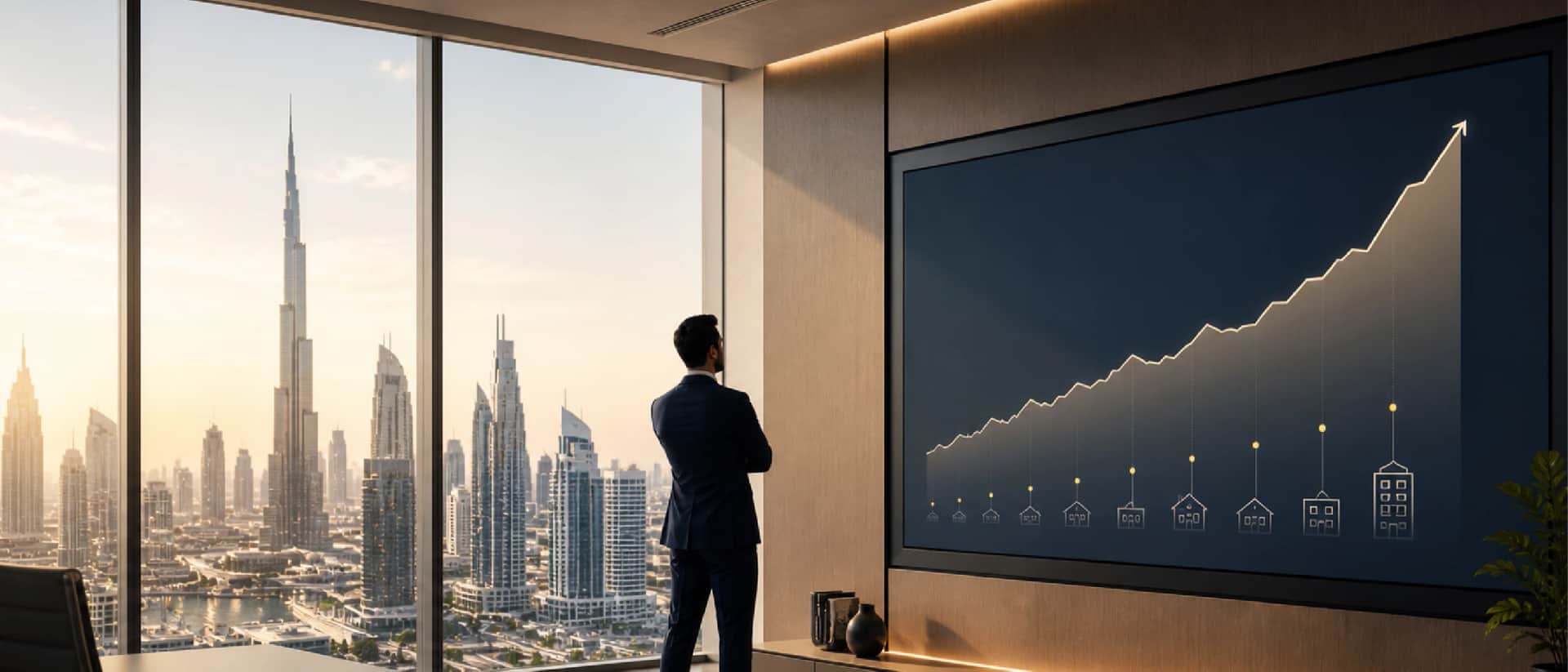
According to Dubai Land Department (DLD) statistics, the Dubai Property Market registered a sharp growth in April 2026, with total real estate transactions reaching AED 68.56 billion. It is more than a 20 percent month-on-month growth.
The surge is not a short-term spike but the result of structural demand drivers such as inflows of foreign investment, population growth, and sustained off-plan development activity across the masterplanned communities of the city of Dubai.
The Dubai Property Market has been able to exhibit its liquidity strength in both residential and commercial real estate segments. It will further help it to establish itself as one of the most dynamic global real estate hubs in 2026.

Yes - investing in Dubai luxury property in 2026 as a long-term strategy is a good opportunity to grow your capital rather than to earn rental income in the short-term. The high-net-worth migration, zero-tax ownership, and lack of ultra-prime supply make the Dubai luxury property market continue to outperform other cities around the world.
In 2025, Dubai registered approximately AED 900+ billion worth of real estate dealings, with luxury areas accounting for a significant portion of the worth increment. The global media reports about the increase in demand for branded homes and waterfront villas, indicating an evident surge in the Dubai luxury property market.
Prime area price increases have been 15-25% per year, and ultra-luxury properties over $10M are still setting sales records. This substantiates the robust momentum in Dubai's luxury property market, backed by international investors.
Nevertheless, rental yields remain at an average of 46 percent, and that is an appreciation. On the whole, luxury property in Dubai is a high-potential, fact-supported investment in long-term wealth creation.