
Adil Raza Khan | March 29, 2025

This guide covers the basic aspects of property management in Dubai. It touches on property maintenance, marketing, listing, tenant relations, and financial and legal management.
Also, it discusses the pros and cons of hiring experts, choosing the best company, and a list of the best property management companies in Dubai.
Curated Opportunities
Flexible buying options for smarter property decisions.
Handpicked properties sorted for the strongest value.
Investment-focused listings with return potential.
Browse Dubai communities with properties for sale.
Property management helps property owners with the overall management of their rental properties. In essence, it helps in dealing with the stress and challenges that come with managing your own property.
Therefore, a property manager’s job responsibility is to serve as a mediator between the tenant and the owner. By doing so, it significantly lessens the responsibilities of the owner and at the same time maintains tenant satisfaction.
Furthermore, property management ensures that the properties are;
They achieve this by doing a variety of activities. This would range from:
Property managers generally handle the ins and outs of your property. They take care of all the aspects in managing your property. This encompasses the processes, legal regulations, and financial matters.
Common Responsibilities of Property Managers:
Property management in Dubai offers a number of services. All these services aim to preserve and increase the value of residential, commercial, and mixed-use properties.
Dubai property management services include:
A very important service of property management companies in Dubai is to provide complete property maintenance.
Property maintenance includes routine repairs to emergency services. This is how companies keep rental properties in excellent condition.
Property management companies apply their experience to create innovative marketing tactics and engage property listings. Companies promote these listings through several channels. These listings aim to emphasize the property’s distinct features, amenities, and location advantages.
Property management companies collect rent and assure on-time payments. In the end, they will provide landlords with complete financial statements. These reports provide transparency which allows homeowners to monitor income and expenses related to their investments.
Property management companies are the primary point of contact for tenants. This is why the property managers will assist them with a variety of tasks. Accordingly, these tasks will include lease paperwork, completing background checks, and assisting in a smooth move-in experience. They also manage tenant inquiries, maintenance requests, and disputes effectively. All of these tasks will essentially aim to establish excellent tenant-landlord relationships.
Property management companies stay updated on Dubai’s property laws. They ensure that all your documents and processes are up to date and comply with legal requirements.
A professional property manager's duty entails handling tenant problems efficiently. They resolve issues by legal standards. Hence, protecting your investment and mitigating legal risks.
Beneficial for international investors unfamiliar with Dubai's property regulations.
Property management companies have a thorough understanding of local market trends. This allows them to determine attractive and profitable rent prices.
Their expert market insights ensure that your property is not vacant for an extended period of time.
Property managers in Dubai utilize marketing strategies. They also do thorough screening procedures to fill in the vacancies with reliable tenants.
Property managers also respond promptly to tenant requests and issues. By doing so, it increases customer satisfaction and lowers the turnover rates.
Property management companies give extensive financial reports to help owners analyze profitability, costs, and overall property performance.
Property managers ensure prompt rent collection, consistent cash flow, and reduced chance of late payments.
This transparency in financial management enables owners to make informed choices regarding investments.
Best Project Finder
Filter opportunities by budget, property type, bedroom mix, and strategy to uncover projects aligned with your investment goals.

Dubai's property management laws follow Law No. 26 of 2007.
This was amended by Law No. 33 of 2008, also known as the "Rental Law." This law discusses the legal responsibilities of both landlords and tenants.
Following all local laws and regulations affecting real estate transactions.
Ensure that you register properties correctly according to the Dubai Land Department requirements.
Property managers draft and maintain the rental agreements to make sure that they are effective and legally binding.
They process the lease agreements and make sure it complies with the Rental Law.
They handle all necessary licenses needed from the Department of Economic Development (DED).
They ensure all client properties meet legal standards to protect the interests of both property owners and tenants.
Property managers will implement rent increases in accordance with applicable laws.
Ensure timely and lawful rent collection, hence ensuring consistent cash flow and lowering the chance of legal complications.
They will use their understanding of Dubai real estate legislation to properly resolve landlord-tenant issues.
Amongst the many new attractions in Dubai, two remarkable landmarks stood out embodying the city’s spirit and vision; the Burj Khalifa and Downtown Dubai.
Tenant screening is a method used by property managers to thoroughly evaluate potential tenants. The goal of the screening is to determine the applicant’s capacity to rent your property.
Capacity of tenants to:
Screening may include:
Moreover, effective tenant screening has various benefits. It not only reduces the likelihood of payment losses and property damage. It also promotes a stable and secure residential community by avoiding difficult tenants.
Overall, property managers in Dubai play an important part in this process. They provide thorough assessments of each candidate at various stages.
Thorough background checks reveal any relevant criminal past. This will demonstrate the tenant’s reliability and safety as a resident.
The evaluation of credit scores and financial history offers specific information. This contains the tenant’s financial stability and capacity to make rent payments on time.
Confirming the applicant’s employment status and income proves their ability to pay the rent.
Communicating with prior landlords provides significant information about the tenant’s leasing habits and history.
These aspects make up a thorough tenant screening process. Also, it allows property managers to make wise choices about lease agreements and tenant selection.
Effective property marketing and advertising are important in getting new tenants. Dubai now has a competitive real estate market. The city has numerous homeowners who seek to make a profit out of their property. This is why landlords must adopt effective marketing techniques to ensure widespread visibility among potential tenants.
Moreover, they can work with real estate property management companies and actively promote their properties. These companies are knowledgeable in various media such as web-based platforms and online classifieds.
Media Channels:
Furthermore, presenting the property in its best light entails capturing its unique qualities. This will enable potential tenants to have an extensive understanding of the property. Working with a property management company in Dubai means being able to leverage their expertise. This means being able to optimize your property’s market presence and attract high-quality tenants more efficiently.

WRITTEN BY
Adil Raza Khan is a Dubai luxury real estate expert with over 13 years of experience in the UAE property market. He is the Chairman of APIL Properties.
Investment Finder
Use smart filters to discover Dubai projects matched to your investment goals.
Try the Investment Finder
The €400K Greece Golden Visa is a mid-tier residency-by-investment pathway requiring a minimum €400,000 investment in residential real estate located in eligible non-prime regions. It offers a 5-year renewable Greek residence permit to investors and their families with no minimum stay period and access to the Schengen area.
The investment should be in a single property of at least 120 sqm, and with specific rules, such as prohibiting short-term rentals. Leasing may be done for the long term however, allowing the generation of income.
Positionally, the €400K tier offers a balanced entry point for Real Estate in Greece—combining capital efficiency, regulatory clarity, and stable rental yield potential within Greece’s supply-constrained housing market, making it suitable for investors seeking EU residency with functional residential assets.

The €250K Greece Golden Visa is a residency-by-investment scheme that provides non-EU investors with a 5-year, renewable residence visa in Greece for an investment of at least €250,000. This threshold is now generally used for certain types of real estate in greece (commercial-to-residential conversion or listed-building restoration).
Investors are allowed to include family members, there is no minimum residency period, and visa-free entry to the Schengen Zone. It is an asset investment as well as a place to live, and can be used to earn rental income or to make long-term capital gains. It remains one of Europe’s lowest-cost entry points into EU residency with structured investment exposure.
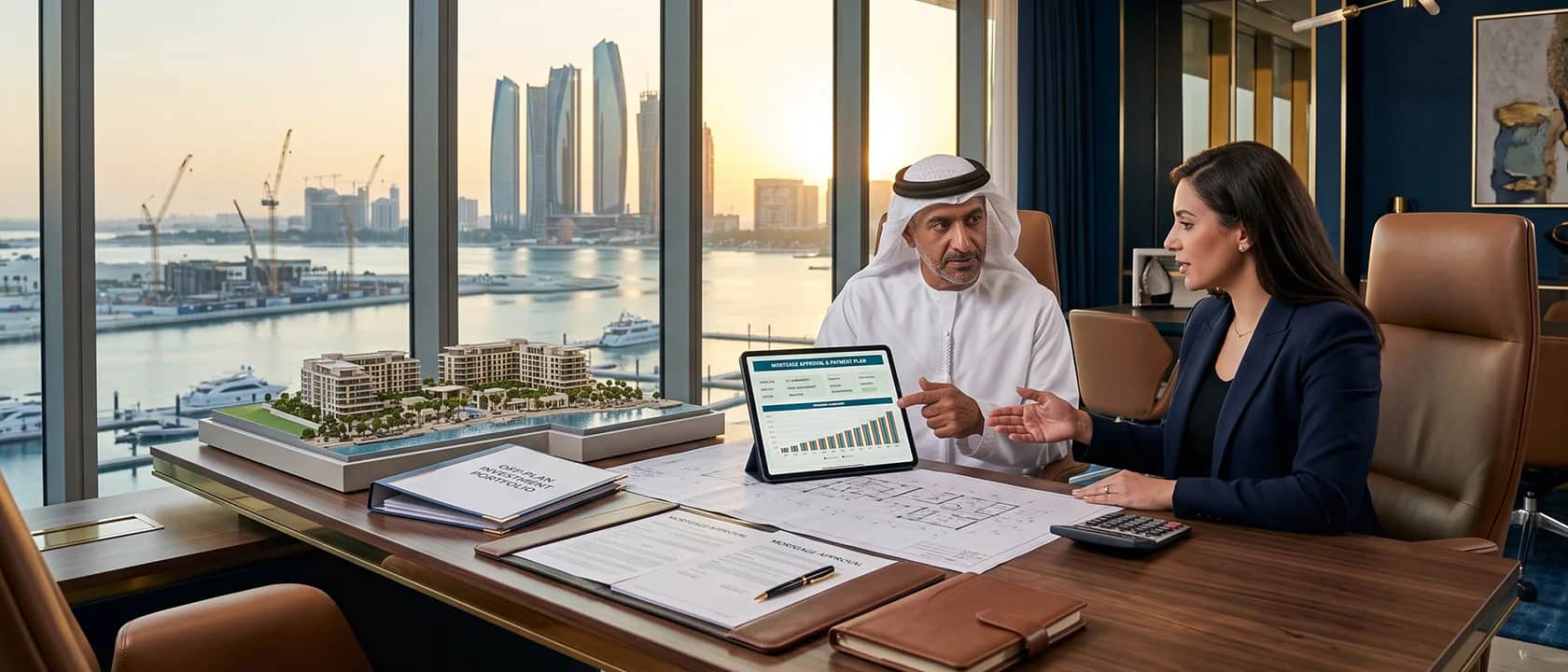
Modon & ADIB have introduced Abu Dhabi’s First Off-Plan Financing through a partnership, allowing eligible buyers to secure up to 75% financing during the construction phase of a Modon off-plan property.
This marks a structural shift in a market historically dominated by cash transactions, where financing was typically only available after project completion. The new model enables buyers to enter off-plan developments with significantly lower upfront capital, combining a 15% payment during construction and 5–10% at handover, while ADIB (Abu Dhabi Islamic Bank) funds the remaining portion throughout the development lifecycle. The solution is exclusively available for future Modon projects, giving the developer a distinct competitive advantage in upcoming launches.
From a market perspective, this framework expands accessibility, improves capital efficiency for investors, and introduces institutional risk-sharing into early-stage real estate transactions. For Abu Dhabi’s off-plan segment—which already accounts for the majority of residential sales value—this financing structure is expected to increase buyer participation, accelerate absorption rates, and strengthen overall market liquidity.